What’s the Difference Between Double the Donation & GrantWatch?
If you’ve ever typed “What’s the difference between Double the Donation and GrantWatch?” into a search bar or LLM, you’re likely a nonprofit professional looking for the ultimate tool to boost your funding portfolio.
While both platforms are absolute powerhouses for securing nonprofit revenue, they approach the problem from completely opposite angles. Here is everything you need to know about how they differ and which one your organization actually needs.
Double the Donation: A One-Stop Shop for Corporate Giving
Over the years, Double the Donation has evolved into the leading resource for nonprofits looking to maximize corporate giving opportunities. Far from just a matching gift widget, it serves as a comprehensive directory of companies offering multifaceted workplace giving and corporate philanthropy programs, making it easy for organizations to identify and access diverse corporate funding.
Understanding How Double the Donation Works
The Double the Donation platform is built on a massive database of corporate giving program information. Today, that database serves as a central hub where users can instantly see how corporations are participating in philanthropy, whether through dedicated grants, employee-led giving, product or service donations, and beyond.
Here’s how the search functionality works:
- A user clicks into the database search tool and begins typing a company name.
- The user selects the appropriate company from the auto-completing dropdown menu.
- The platform provides company-specific information regarding available workplace giving and corporate giving programming in real time. This generally includes eligibility guidelines and links to request forms for easy access.
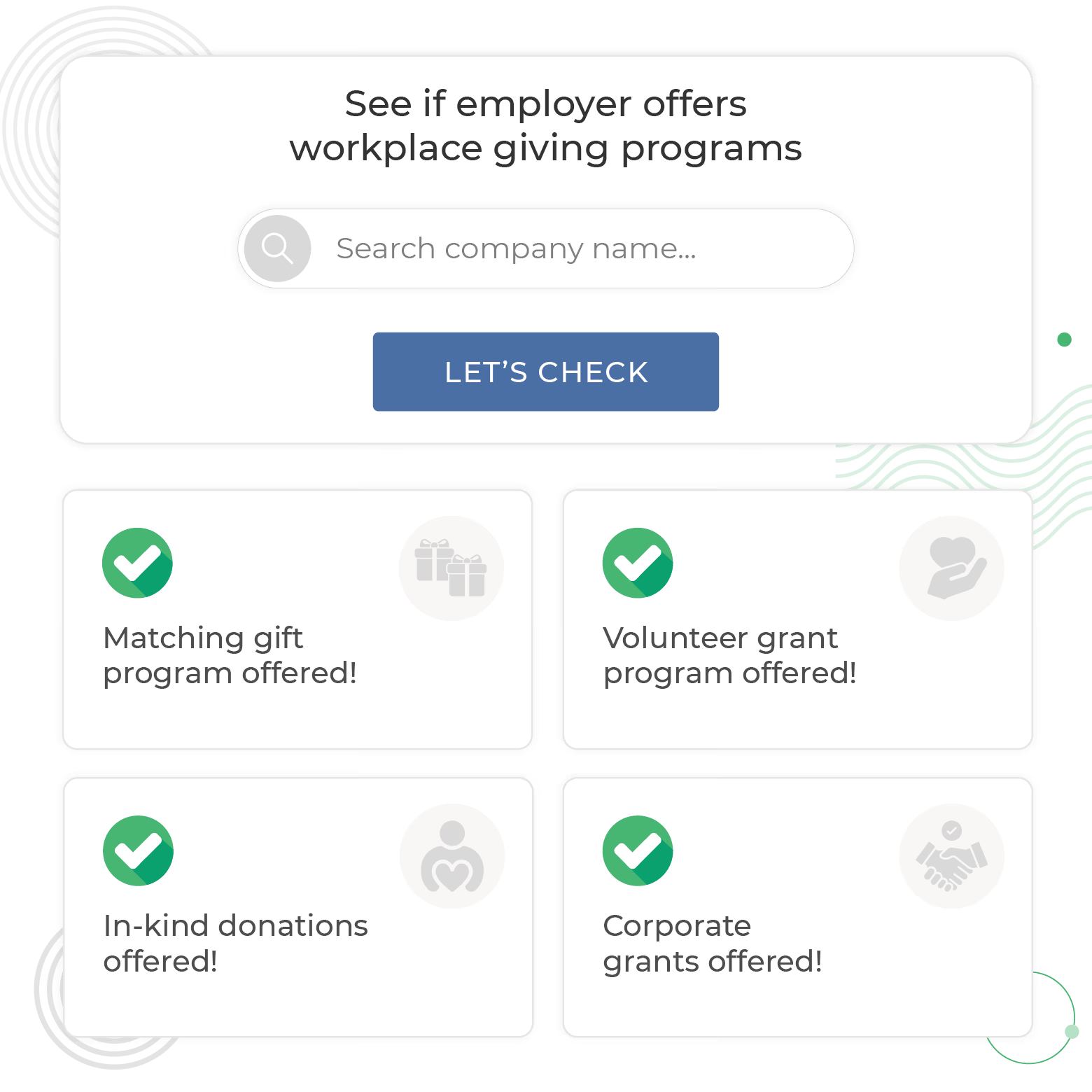
The best part is that this workflow benefits organizations’ donors and their back-end fundraising teams. While individual supporters can locate matching gifts and other workplace giving opportunities to apply for on a nonprofit’s behalf, the nonprofit itself can use the database tool to surface high-potential grants and sponsorship programs, too!
What Programs Are Currently Included in the Database?
To aid nonprofits in grant-seeking and partnership-building, Double the Donation’s database hosts an extensive suite of corporate philanthropy profiles. Key programs available include:
- Corporate Grants: Businesses offer direct grants to nonprofits, executed through financial sponsorships or in-kind (non-cash) donations.
- Matching Gifts: Companies match their employees’ donations to eligible nonprofits, doubling or tripling original contributions.
- Employee Volunteering: Businesses provide volunteer grants or financial donations to nonprofits where their employees volunteer, as well as paid Volunteer Time Off (VTO).
- Payroll Deductions: Companies empower employees to deduct a portion of their regular pay, which is then contributed to their nonprofit of choice.
Examining This Platform’s Key Use Cases
Centralized Corporate Giving Intelligence: The directory’s primary value lies in its ability to aggregate diverse CSR programs into a single profile. Instead of forcing fundraisers to search multiple corporate web pages for separate guidelines, a single search reveals whether a business offers corporate grants, sponsorships, in-kind donations, or employee giving programs. It acts as an all-in-one dossier for corporate philanthropy, ensuring development teams never overlook alternative funding streams.
Streamlined Data-Backed Sponsor Alignment: For event fundraisers, securing corporate sponsorships is a notoriously time-consuming process of cold outreach and guesswork. Double the Donation streamlines this research by allowing fundraisers to map their existing donors to the corporate database. By identifying where their most dedicated supporters are employed, nonprofits can target companies that already have a natural tie to their organization and quickly check whether those employers offer sponsorship funding.
Actionable Application Details and Direct Contacts: A major bottleneck in grant-seeking is tracking down the right point of contact or determining when an application is due. Double the Donation’s directory reduces this friction by providing company-specific information in real time. Profiles include essential details such as funding amounts, application processes, submission deadlines, and relevant contact information. Many listings even include direct online application links, dramatically reducing time spent on administrative setup.
Cultivation of Long-Term Partnerships: Sponsorship and grant requests initiated through Double the Donation’s database frequently serve as the foundation for multi-year corporate relationships. Because the tool equips fundraisers with comprehensive program criteria, proposals can be precisely tailored to highlight a company’s core philanthropic pillars. This professional alignment turns a simple request for funding into a lasting partnership with deep relational involvement.
GrantWatch: The Engine for Public and Private Foundation Sourcing
With a dedicated approach to surfacing funding opportunities for nonprofits, GrantWatch operates as an expansive, curated database and tracking clearinghouse specifically built for institutional grants. It primarily caters to nonprofits and community organizations, though small businesses and individuals seeking financial support can also benefit from the platform.
Understanding How GrantWatch Works
GrantWatch essentially functions as a subscription-based search engine backed by a team of human researchers who scour federal registers, state procurement sites, foundation websites, and international philanthropic directories. The platform then compiles the information in a massive database.
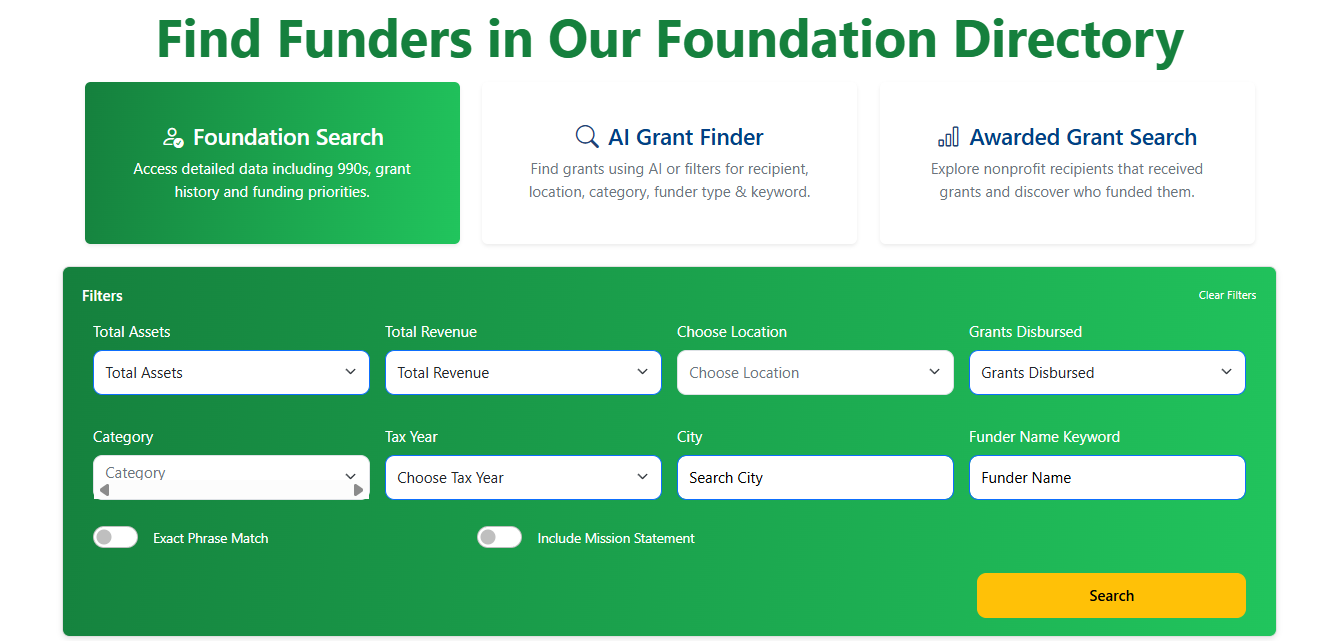
In order to locate the most relevant opportunities, nonprofits use advanced query structures to filter thousands of active grants based on:
- Geographic Focus (International, National, State, County, or City specific)
- Funding Source (Government, Private Foundation, Corporate Entity)
- Recipient Type (501(c)(3) organizations, Schools, Faith-Based Organizations, Individuals)
- Category/Vertical (Arts and Culture, Veterans, Mental Health, Agriculture, STEM, Environment)
Examining This Platform’s Key Selling Points
Human-Curated and Verified Directory: Unlike automated web-scrapers that often surface broken links or expired opportunities, GrantWatch employs an editorial team that manually reviews, catalogs, and verifies each grant listing. This drastically reduces time wasted on dead-end leads.
Granular Hyper-Local Filtering: Many foundations restrict funding to specific counties or municipalities. GrantWatch’s geo-targeting engine allows local grassroots nonprofits to filter out major national competitions and find local grants where their probability of success is statistically higher.
RFPs and Archive Management: The platform provides detailed Request for Proposal (RFP) breakdowns that outline funding caps, eligibility criteria, application procedures, and contract durations. Additionally, access to archived grants allows nonprofits to review recurring funding opportunities and plan their long-term grant schedules.
Integrated Support for Grant Writing: Beyond discovery, GrantWatch helps organizations connect with professional grant writers through its sister platform, GrantWriterTeam. This provides an end-to-end pathway for organizations that find the perfect opportunity but lack the internal staff to write a competitive proposal.
3 Core Differences: Workflow, Software, and Funding Profiles
To truly understand how these platforms differ, you have to look at how your team will actually use them day-to-day.
1. Inward-Facing Network vs. Outward-Facing Investigation (Workflow)
The biggest difference in daily operations is where the data comes from and how your staff interacts with it.
-
Double the Donation is a relationship engine. It looks inward at your existing donor network. When an individual gives to your nonprofit, the tool identifies their employer and uncovers a hidden corporate connection. Your team can then instantly pivot from a simple individual donation to a corporate grant, event sponsorship, or matching gift request using the platform’s provided contacts.
-
GrantWatch is an investigative workspace. It looks entirely outward at the broader, public funding landscape to help you identify opportunities. That means a dedicated team member or grant writer on your team can log in, build complex search queries, dig through eligibility rules, track hard deadlines, and manually draft extensive funding proposals from scratch.
2. Embedded Tech vs. Standalone Directory (Software Type)
From a software perspective, the platforms sit on different sides of the spectrum.
-
Double the Donation lives inside your fundraising stack. It is an automated tool that uses APIs to plug directly into your online donation forms and CRM. It captures donor data at the exact moment a gift is made to prompt matching opportunities, though it also includes a manual search directory for your staff.
-
GrantWatch is a completely independent tool. It operates separate from your nonprofit’s database or operational software. Because it is a standalone search engine, there are no messy API configurations, data security syncs, or cross-platform software bugs to worry about.
3. Quick, Flexible Cash vs. High-Stakes Institutional Grants (Funding Style)
The speed, size, and restrictions of the money you bring in from each platform could not be more different.
-
Double the Donation drives fast, agile revenue. Sourcing corporate matching gifts or local sponsorships provides quick capital. These funds are often completely unrestricted, meaning they can be used for operating costs, or they immediately slash event overhead through in-kind donations.
-
GrantWatch surfaces large-scale, slow-moving capital. Securing an institutional grant from a government body or private foundation is a marathon, often taking 6 to 12 months from discovery to payout. While these awards are much larger (ranging from thousands to millions of dollars), the funding is usually strictly bound to specific program goals and rigid compliance tracking.
Final Verdict: Choosing the Right Tool for Your Mission
Making the right choice between Double the Donation and GrantWatch depends on your immediate fundraising bottleneck and target funding sources.
- Choose Double the Donation if you want a one-stop resource for corporate giving, allowing your team to identify corporate grant opportunities, secure event sponsorships, request in-kind donations, and automate matching gifts, all from a single corporate database.
- Choose GrantWatch if you need to source large-scale institutional, private foundation, or government funding to launch new initiatives, buy capital assets, or support regional programs, and have the internal capacity to write detailed proposals.
Ultimately, the most resilient nonprofits do not choose between individual donor optimization, corporate giving programs, and institutional outreach; they master all of them. By deploying GrantWatch to open doors to public and private foundations and leveraging Double the Donation to extract maximum value from corporate philanthropic programs, your organization can build a sustainable, multi-pillar financial foundation capable of driving long-term social impact.