Promoting Volunteer Grants and PVTO FAQ: Strategies to Maximize Corporate Volunteering Revenue
Many supporters assume their contribution ends the moment their volunteer shift concludes. However, for nonprofits leveraging corporate volunteering programs, that time is often just the beginning of the financial impact. The primary barrier to accessing this revenue is rarely a lack of eligibility, but rather a lack of awareness regarding volunteer grants and paid volunteer time off (PVTO).
In this guide, we will explore actionable promotional strategies, from website optimization to email segmentation, that utilize fundraising software to help you close the communication gap. We will discuss how to educate your supporters, streamline grant eligibility checks, and ultimately drive more engagement through workplace giving.
1. How can my nonprofit promote volunteer grant programs effectively?
Your nonprofit can promote volunteer grant programs through a dedicated volunteering page, email campaigns, social media, and event announcements. In promoting, highlight both volunteer hours and potential grants, and include examples of companies with generous volunteer grant programs, like Microsoft or Google. With clear instructions and a volunteer grant plugin, you can help supporters find eligibility quickly, increasing submissions and improving donor engagement.
2. Where should my nonprofit place volunteer grant information on our website?
While having a dedicated “Ways to Give” page is helpful, the most strategic placement for volunteer grant information is on your existing volunteer page.
Your volunteers are already visiting this page to sign up for shifts, read FAQs, or check event schedules. By embedding a searchable corporate giving database directly onto this existing page, you capture supporters at the moment their intent is highest, without forcing them to navigate to a new section of your site.
This approach offers a lower technical lift and higher discoverability:
- You don’t need to design a new landing page or restructure your site map. You simply add a plugin or a text block to a page that is already live and receiving traffic.
- Most volunteers look for “volunteering” information rather than “grant” information. Placing the search tool here ensures that the program is discovered organically by the people most likely to use it.
Once the tool is live on your main volunteer page, consider adding it to your registration forms and confirmation screens. Prompting a volunteer to check their eligibility immediately after they sign up for a shift capitalizes on their engagement momentum.
3. How can my nonprofit integrate volunteer grants into email campaigns?
The most effective email campaigns do not treat every volunteer the same. To maximize engagement, you must move beyond generic “blast” newsletters and use segmentation based on the data you have.
Your strategy should branch into two distinct paths: One for eligible supporters and one for those whose eligibility has yet to be determined. For supporters where you have already captured employment data (e.g., via a registration form) and know they work for a grant-eligible company, your email should remove all friction by providing a direct link to their company’s specific submission portal or instructions, and asking them to submit. Meanwhile, for the segment of your list where employment data is missing, your email should direct them to the searchable database embedded on your website. This invites them to research their eligibility while simultaneously capturing their employment data for future outreach.
Managing these segments manually can be challenging. Integrated fundraising software can automate email streams immediately after a volunteer signs up or logs hours, ensuring the right message reaches the right person at the right time.
4. How can my nonprofit highlight high-value corporate volunteer programs?
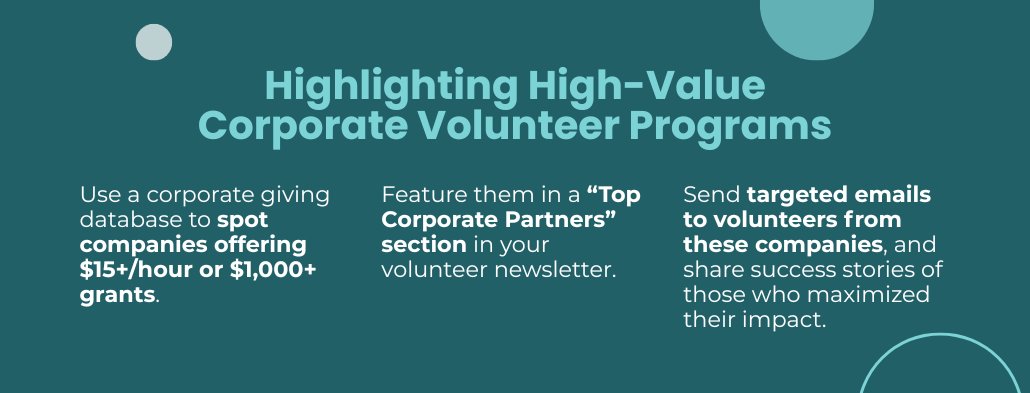
The most efficient way to identify “high-value” opportunities, such as companies that pay $15+ per volunteer hour or offer $1,000+ grants, is to leverage a corporate giving database like Double the Donation.
Instead of guessing which local employers might have programs, these databases allow you to screen your existing volunteer list against thousands of corporate profiles. They will instantly reveal companies with generous programs (like Microsoft, offering $25/hour or Disney, offering up to $2,000 grants) and active “Dollars for Doers” programs where employees are already culturally conditioned to submit requests.
Once you have used the database to identify these pockets of value, you can prioritize your outreach. Start by creating a “Top Corporate Partners” section in your volunteer newsletter, specifically listing the companies you know offer generous grants. Then, send segmented and targeted emails to volunteers from high-value companies to remind them that their specific grant program can double their impact. Lastly, share a story of a volunteer from one of these companies who successfully funded a project just by logging their hours, proving to their colleagues that it is worth the effort.
5. When is the best time to notify supporters about Paid Volunteer Time Off (PVTO)?
Timing is the single most critical factor for PVTO success because, unlike other forms of workplace giving, it cannot be done retroactively.
While volunteer grants are requested after the service is complete, Paid Volunteer Time Off is technically a form of “leave” (similar to vacation or sick time). Most corporate HR policies require employees to request and secure approval for this time before their shift begins. If you wait until the volunteer checks out to tell them about the program, it is already too late for them to utilize the benefit.
To capture this opportunity, you must move your communication upstream. You should automate your fundraising software to trigger an eligibility prompt immediately after a supporter registers for an event, not after they attend it:
“Thanks for signing up! Before you mark your calendar, check if your employer offers Paid Volunteer Time Off. You might be able to volunteer during the workday without using your vacation time.”
By prompting them immediately upon registration, you give the volunteer the lead time they need to submit the request to their manager, ensuring they can commit to the shift stress-free.
6. How can promoting Paid Volunteer Time Off help recruit more volunteers?
The number one reason people cite for not volunteering is a lack of time due to work commitments. Promoting PVTO is a strategic recruitment tool that directly neutralizes this primary objection. By actively marketing the fact that many employers offer Paid Volunteer Time Off, you solve the “work vs. service” conflict for your supporters.
Your nonprofit can use PVTO for:
- Recruitment (Getting them in the door): When you advertise volunteer opportunities, lead with the message: “Volunteer without missing a paycheck.” This opens your candidate pool to working professionals who otherwise could not afford to take a half-day off.
- Retention (Keeping them longer): Volunteers using PVTO are often able to commit to longer shifts (e.g., a full 8-hour day) rather than squeezing in a rushed hour during lunch or after work. Because they are “on the clock” for their employer while serving you, they are less likely to cancel last minute due to work emergencies.
By educating your audience about these programs, you position your organization as a partner in their work-life balance, which is a powerful tactic for long-term volunteer retention.
7. How can my nonprofit use storytelling to increase volunteer grant participation?
To increase volunteer grant participation through storytelling, your nonprofit can:
- Highlight the direct impact of volunteer hours and grants in your stories.
- Show how a few hours translate into measurable financial support.
- Use visuals, videos, and infographics to increase engagement.
- Incorporate volunteer testimonials for authenticity.
- Integrate a fundraising tool to ensure donors can confirm eligibility instantly, linking story to action.
Through effective storytelling, you can motivate donors to log hours and submit grant requests.
8. How can my nonprofit involve staff and volunteers in promoting volunteer grants?
Your staff can mention grants during donor calls, events, or volunteer orientation, while your volunteers can encourage peers to track hours during their volunteer days:
- During orientations, clearly explain what volunteer grants are and how they work.
- In regular communications such as email newsletters, internal meetings and social media channels, consistently remind staff and volunteers about available programs.
- On your website, highlight volunteer grants and VTO programs on your existing volunteering page with easy-to-follow, step-by-step guides on how to log volunteer hours and submit a grant request through their employer’s platform. Provide links to corporate databases that contain information on participating companies and their specific guidelines.
Training teams on effective fundraising tools can help your team guide supporters effectively and ensure consistent messaging across outreach.
9. What are the benefits of promoting volunteer grants, and how can we get started?
The primary benefit of promoting volunteer grants is the creation of a new, unrestricted revenue stream from resources you already have. Your volunteers are already giving their time, so by promoting these programs, you empower them to double their impact without opening their wallets.
Beyond revenue, promoting these programs deepens donor stewardship. It signals to your supporters that you value their time as much as their money, which can increase volunteer retention rates.
To get started, integrate volunteer grants into your nonprofit’s existing communication channels using these examples:
- On your website: Do not hide this information in a PDF. Create a dedicated section on your existing volunteer page that explains the concept simply: “Did you know your employer might donate $25 for every hour you volunteer?” Embed a search tool directly here so they can check eligibility instantly.
- On social media: Use platforms like LinkedIn and Facebook to share informational graphics. Tag top local employers who offer grants. This not only educates volunteers but strengthens corporate relationships.
- In automated emails: Add a standard prompt to your volunteer confirmation and thank-you emails that invites supporters to check if their company will pay for the hours they logged. This catches the supporter at the peak of their engagement.
Actionable Strategies to Leverage Corporate Volunteering
Bridging the gap between a volunteer’s enthusiasm and a corporate check requires consistent, clear communication. When you integrate volunteer grants and matching gifts into your standard storytelling and outreach, you empower your supporters to maximize their impact without additional cost.
We encourage you to audit your current volunteer registration forms today. Adding a simple checkbox or search tool for employer data can be the first step toward significant revenue growth and improved donor stewardship.
To learn more about corporate volunteering and other forms of workplace giving, explore more resources from Double the Donation and implement best practices, streamline processes, and capture more volunteer grants today.